
Black American Literary Institute

The permanent institutional home of Black American literature, preserving the works, authors, voices, and ideas that shaped a people.

State of the Institute

An ever-growing record of Black American literary achievement.

93

Books Preserved

57

Authors Preserved

14

Literary Works

6

Collections

A Curator’s Welcome

Welcome to the Black American Literary Institute

You have entered the Black American Literary Institute — a permanent home for the literature, authors, and ideas that have shaped Black American letters from the earliest published works to the living present.

The Curator Is Available

Ask. Explore. Understand.

Literary Wings

The Wings of the Gallery

Each Wing is an immersive interpretive environment. Enter a Wing to understand the movement before exploring its collections, books, and authors.
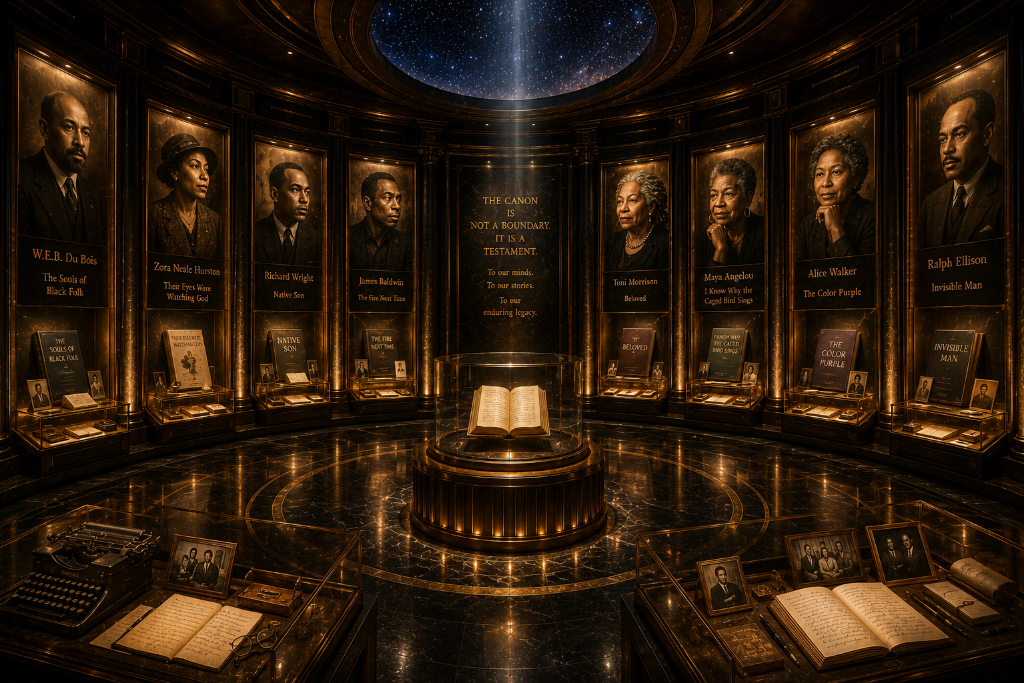
The Canon Chamber — a monumental circular sanctuary welcoming visitors to the Black Canon Wing. A breathtaking rotunda of polished black marble with gold-veined accents, rich walnut wood, and dark bronze features a large circular oculus opening to a star-filled night sky, with a beam of light descending to an illuminated central pedestal holding an open canonical book in a glass display case. Around the perimeter, eight exhibition alcoves pair museum-quality oil portraits of canonical Black American authors — including W.E.B. Du Bois, Zora Neale Hurston, Richard Wright, James Baldwin, Toni Morrison, Maya Angelou, Alice Walker, and Ralph Ellison — with their major works displayed as first-edition treasures. Polished stone floors with circular inlays, warm amber architectural lighting, restrained bronze detailing, elegant columns, and carefully balanced symmetry create an atmosphere of permanence, reverence, and cultural significance — a national literary treasury where the greatest works of Black American literature are preserved as enduring achievements of American civilization.
The Foundational Works

Black Canon

The foundational and enduring works of Black American literature — texts of exceptional significance that have shaped generations of writers, readers, scholars, and communities.

Enter Wing
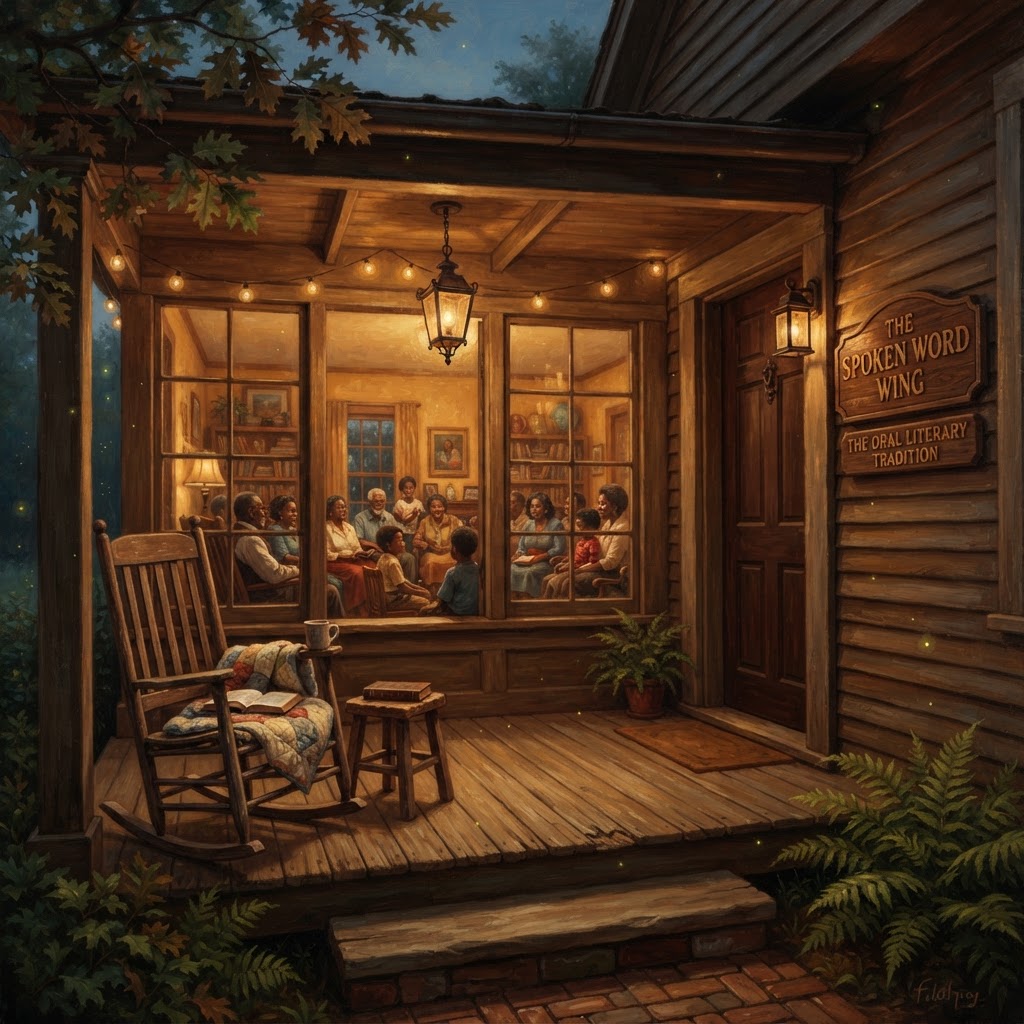
The Porch at Dusk — an intimate twilight scene welcoming visitors to The Spoken Word Wing. A weathered wooden porch beneath hanging lantern light, an empty rocking chair and a small stool beside it, suggesting the place where stories pass from elder to child. Beyond the porch, the soft golden glow of a gathered community is visible through warm windows. Fireflies drift in the humid evening air. Deep amber and rich brown tones, painterly cinematic atmosphere, no microphones or modern technology — a sense of living memory, intergenerational transmission, and the threshold between the spoken and the remembered.
The Literature Before the Page

The Spoken Word

The Black American literary tradition that lived through the human voice — preaching, oratory, performed poetry, storytelling, testimony, comedy, and the recorded voice.

Enter Wing
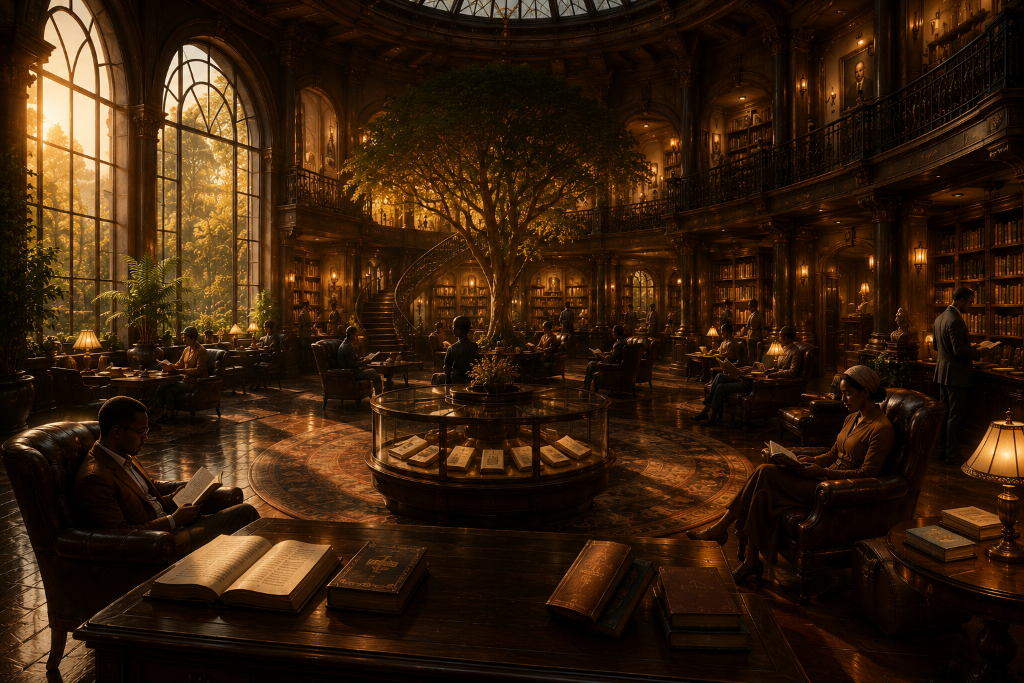
A warm, cinematic literary sanctuary dedicated to Black American poetry — a mature central tree rises through the heart of the hall, monumental arched windows pour golden afternoon light across elegant reading areas with leather chairs and softly glowing lamps, quiet visitors read and reflect, and soaring bookshelves with graceful balconies line the curved walls.
The Voice of Verse

Poetry Hall

The range and power of Black American poetry across generations — verse as art, testimony, memory, protest, and witness.

Enter Wing
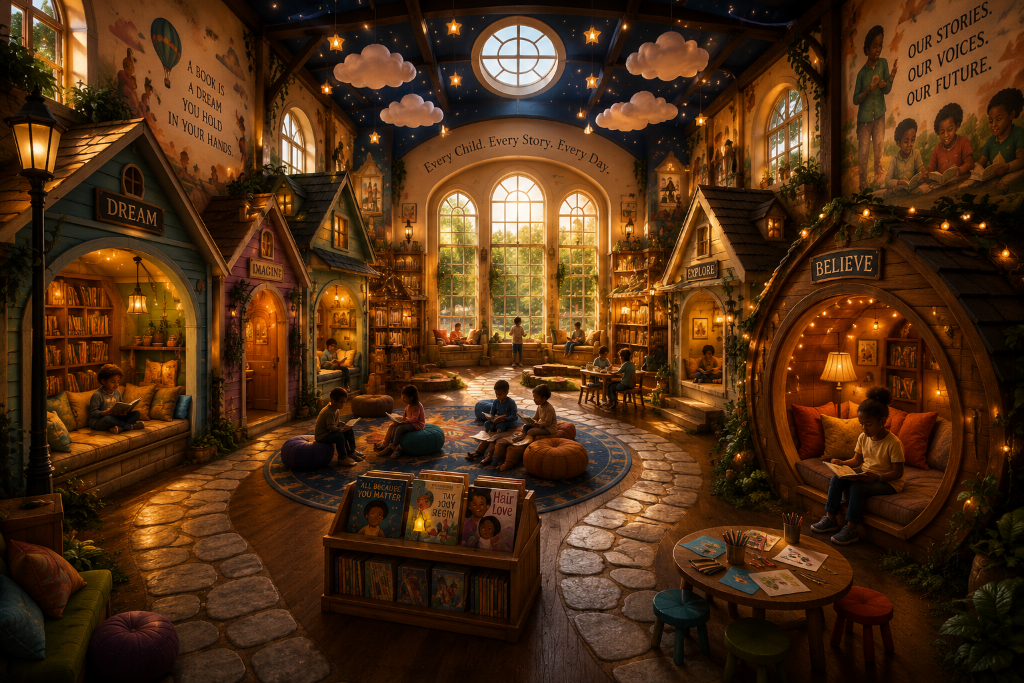
A warm Story Village welcoming visitors to the Children’s Literature Wing — charming reading cottages, cozy story nooks, window seats, winding stone paths, bookshelves, and gathering spaces filled with natural light from skylights and large windows, complemented by warm lantern lighting, where children and families read and explore together.
The Next Generation

Children's Literature

Literature for young Black readers — the stories, picture books, and narratives that cultivate identity, imagination, and pride in the next generation.

Enter Wing
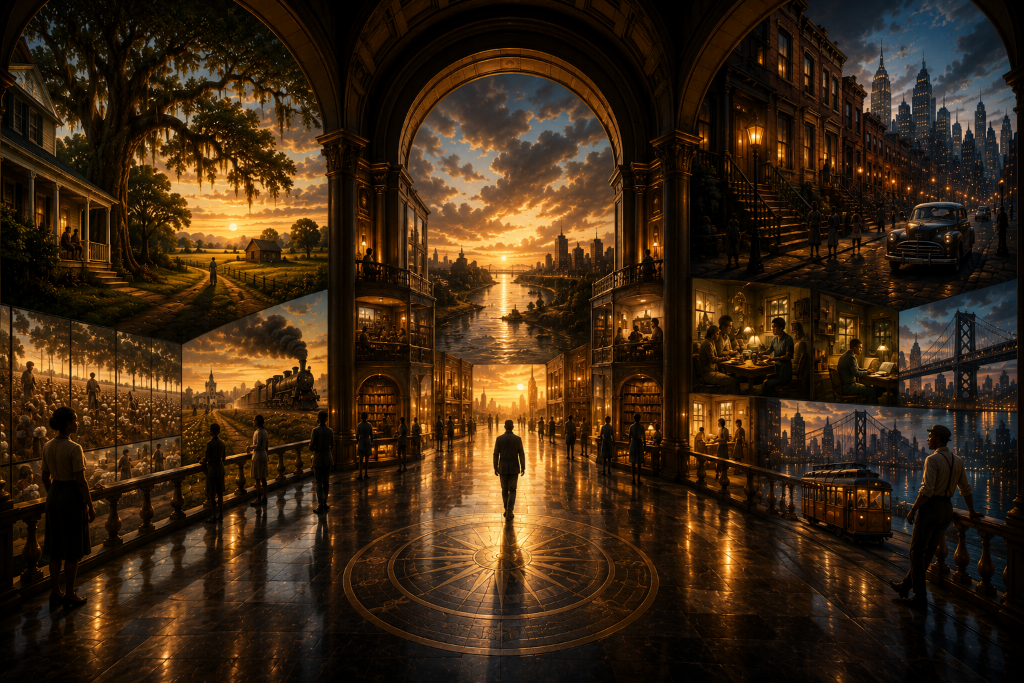
A cinematic environmental entrance to the Black American Novel Wing — a grand architectural gateway whose arches and galleries open into interconnected American landscapes: rural Southern porches, rivers, railroads, small towns, city brownstones, and industrial skylines, all unified by warm golden-hour light, deep atmospheric perspective, and subtle figures walking toward the threshold of countless stories.
The Form

Black American Novel

The novel as a vessel for Black American life — from the earliest attempts at long-form fiction through the masterworks that have redefined American literature.

Enter Wing
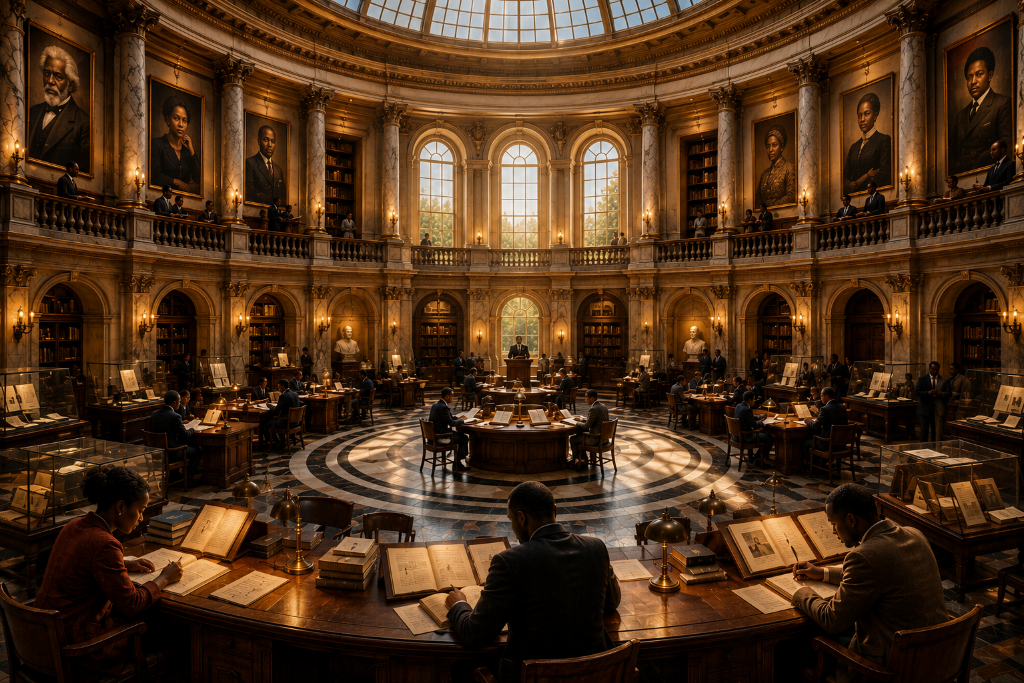
A monumental Forum of Ideas welcoming visitors to the Political Thought & Essays Wing — a grand civic hall with soaring neoclassical architecture, marble columns, a domed skylight flooding the space with warm amber light, a central circular forum surrounded by reading tables and archival display cases, museum-quality oil portraits of influential Black American intellectuals lining the upper gallery, polished marble floors with circular geometric patterns, brass library lamps, and scholars quietly reading, writing, and debating ideas in an atmosphere of dignity, scholarship, and civic purpose.
The Public Intellect

Political Thought & Essays

The essays, manifestos, and works of political thought that have shaped Black intellectual discourse and public debate.

Enter Wing
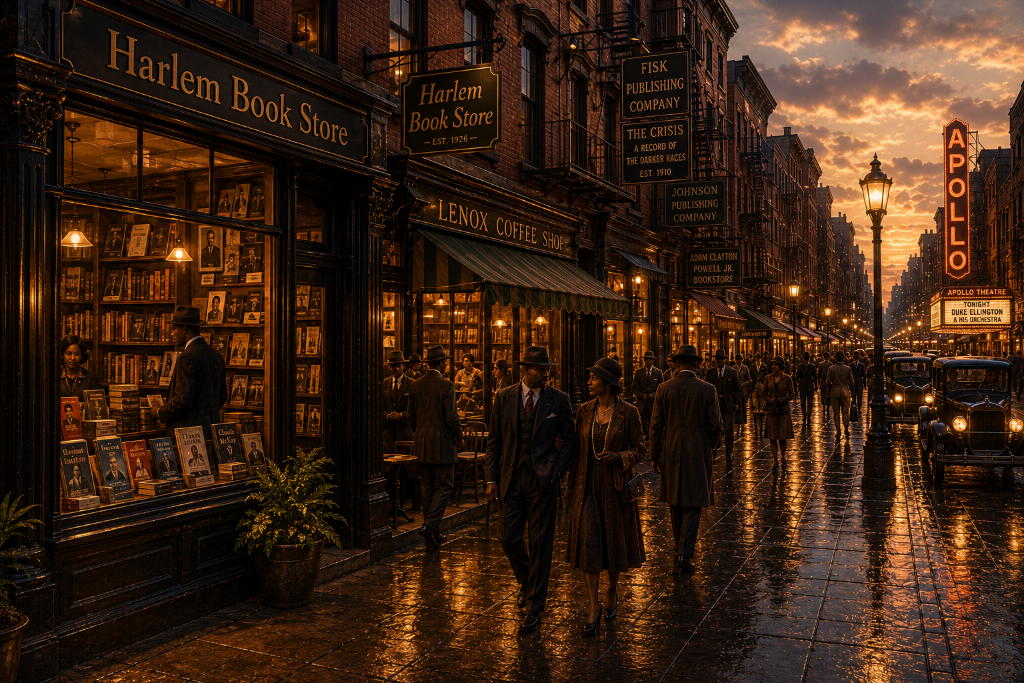
Cinematic golden-hour entrance to the Harlem Renaissance district — a warmly illuminated independent bookstore, brownstone architecture, publishers, theaters, rain-soaked sidewalks, and vintage automobiles evoking the literary neighborhood of late-1920s Harlem.
1918–1937

Harlem Renaissance

The Harlem Renaissance was a flowering of Black art, literature, music, and intellectual thought centered in Harlem, New York, during the 1920s and 1930s — a cultural awakening that announced Black America as a creative force in American life.

Enter Wing
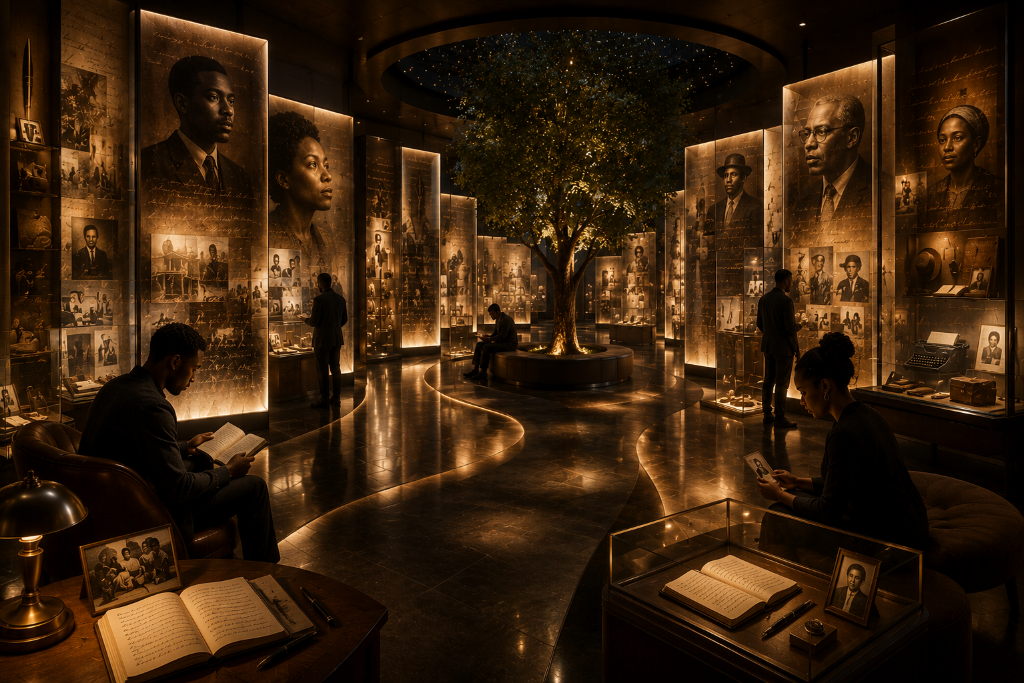
The Hall of Lives — an immersive museum of memory welcoming visitors to the Autobiography & Memoir Wing. A gently curving pathway winds through softly illuminated translucent archival panels glowing warmly from within, displaying sepia-toned portraits, family photographs, handwritten journal pages, personal letters, and treasured artifacts. At the center stands a beautiful illuminated Memory Tree atop a circular dark wood and bronze bench, its dense glowing foliage reaching toward a circular opening in the ceiling revealing a starry night sky. Intimate seating areas with dark leather armchairs and brass desk lamps invite quiet reflection. Rich walnut wood, dark bronze, polished stone floors, and museum-quality glass display cases create a timeless, contemplative atmosphere where every life is remembered.
The Testimonial Tradition

Autobiography & Memoir

The first-person narratives and memoirs through which Black Americans have testified to their own lives, experiences, and histories.

Enter Wing
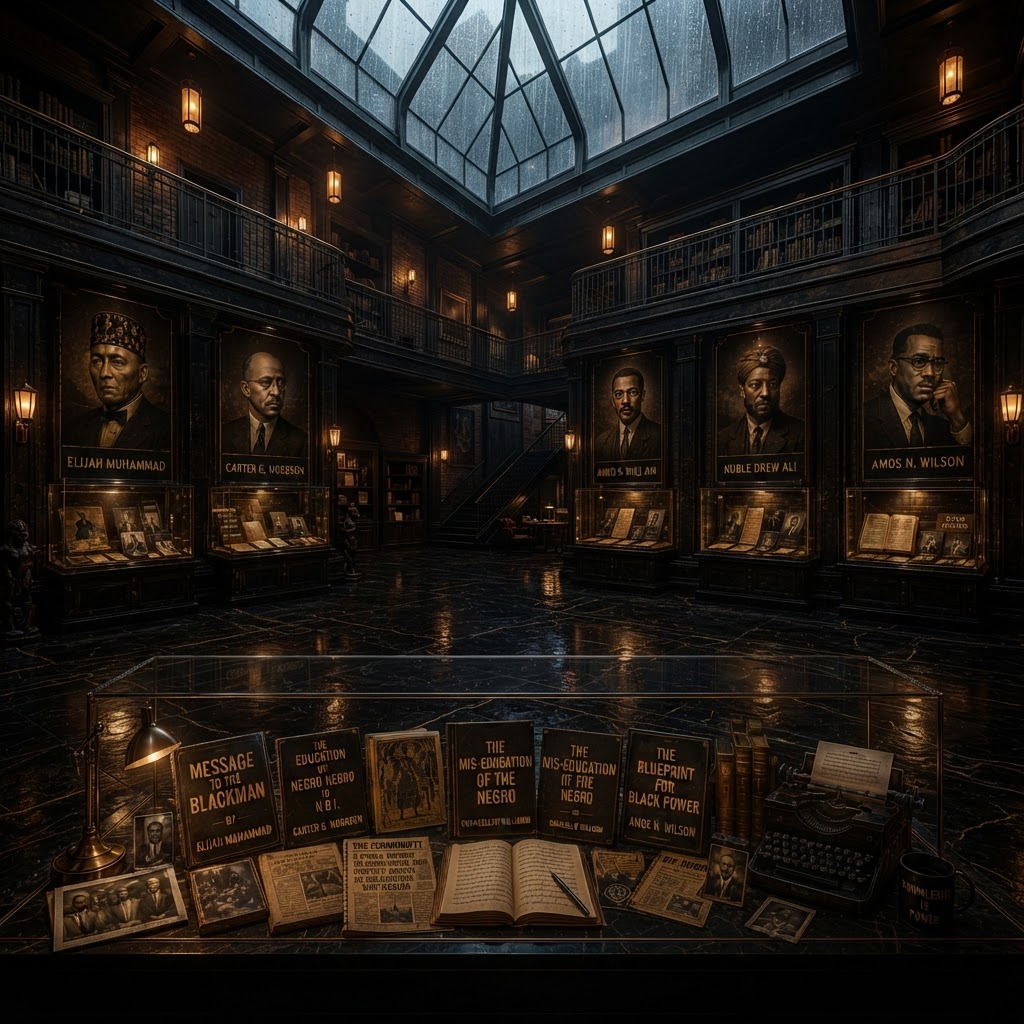
The Shadow Archive — a hidden institutional repository welcoming visitors to the Canon Noir Wing. A grand industrial-Art Deco interior stretches into the distance beneath towering glass skylights where rain falls gently overhead. Wet black marble floors reflect warm amber architectural lighting, creating a cinematic atmosphere of mystery, reflection, and intellectual exploration. Rich walnut shelving, dark bronze detailing, wrought iron balconies, brick walls, and elegant archival display cases line the space. Pools of warm light illuminate rare books, handwritten manuscripts, historical newspapers, journals, typewriters, and carefully preserved first editions. Museum-quality oil portraits of consequential Foundational Black American thinkers — including Carter G. Woodson, Elijah Muhammad, Amos N. Wilson, and Chancellor Williams — are displayed in unified classical museum style. A central glass-topped display table houses vintage books, a black typewriter, framed photographs, and newspaper clippings illuminated by a small brass desk lamp. The architecture encourages visitors to wander deeper into the archive, feeling that every corner contains another overlooked intellectual treasure — a hidden archive where visitors discover influential Black American scholarship that challenged accepted narratives and expanded the boundaries of Black thought.
The Recovered Tradition

Canon Noir

The overlooked, neglected, and recovered works of Black American literature — texts deserving of renewed attention and scholarly recovery.

Enter Wing

Essential Reading Library

Where Should I Begin?

A curated starting point for new readers — the foundational works that form the cornerstone of Black American literary tradition.
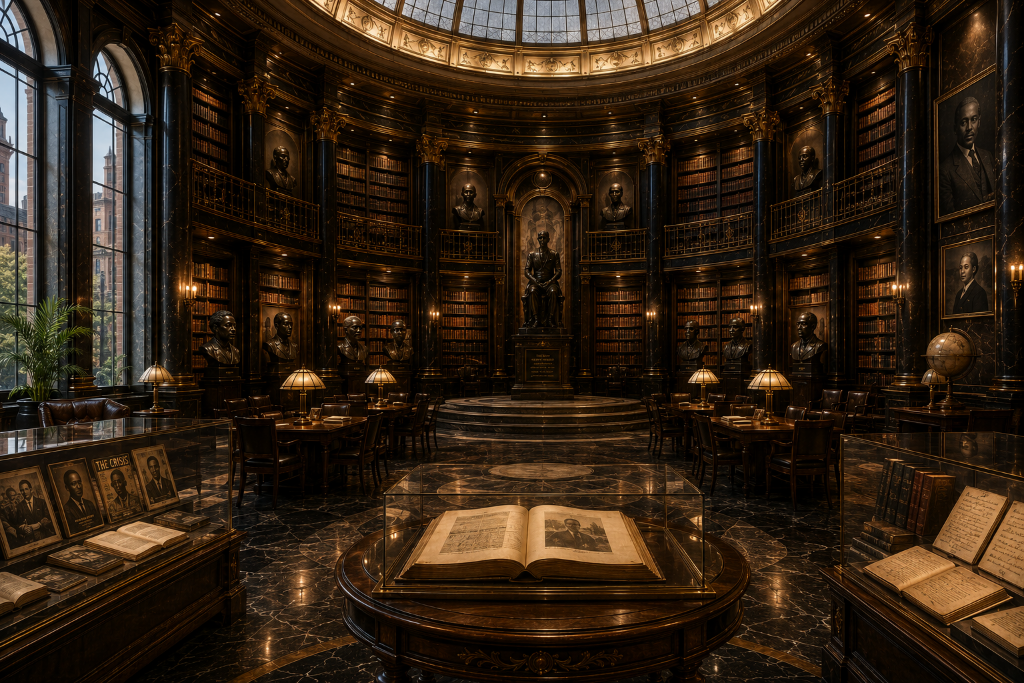
Monumental circular library honoring foundational Black American literature.

The Essential Reading Library

Begin with the works that shaped a tradition. The Essential Reading Library gathers the foundational texts every reader should encounter — novels, poetry, essays, narratives, and speeches that have proven indispensable across generations.

14 works preserved across twelve foundational collections

Literary Journeys

Guided Pathways Through Literature

Curated reading sequences connecting interconnected works across eras, themes, and movements.

Preservation Intelligence

The State of the Collection

Live metrics from the Literary Institute database — updating automatically as new works are preserved.

93

Books Preserved

57

Authors Preserved

14

Literary Works Preserved

6

Active Collections

7

Literary Journeys

6

Featured Works

Recently Added to the Library

The Color Purple

Alice Walker

Letter from Birmingham Jail

Martin Luther King Jr.

Beloved

Toni Morrison

I Know Why the Caged Bird Sings

Maya Angelou

The Souls of Black Folk

W.E.B. Du Bois

Total Literary Assets Preserved: 164 · Metrics update automatically as new content is published.

Continue Exploring

Continue Your Exploration

Supporting resources for your journey through the Literary Institute — deeper pathways into books, authors, timelines, and preservation.

"Every voice preserved is a future reader inspired."

Black American Literary Institute · BHED